
Fast Flexible and Affordable
Discover Our Playground Equipment Solutions Today!

 May 12,2026
A real estate agent in Texas had a 150m² retail spot empty for two cycles. A trampoline park operator took it, but not the standard “one big bounce floor” layout. The operator packed the space with five zones: open jump, dodgeball court, foam pit, spider wall, and a ninja course. The equipment list specified 200 springs per court instead of the usual 150. Why extra springs? Because a 45kg child needed enough rebound for a good bounce, while a 75kg adult shouldn’t sink the mat into the frame. The spring density also spread wear across more attachment points, so each spring saw fewer cycles.
A trampoline park that serves both kids and adults needs a spring system that works for both. This article explains how spring count changes bounce feel, why five activity zones hold customers longer than one big court, and where the maintenance budget actually goes.
A trampoline court has springs attached to the mat and the frame. Fewer springs means each spring carries more load. For a light child, the mat may feel stiff because the child’s weight doesn’t stretch the springs enough. For a heavy adult, the mat may feel too soft because the springs stretch too far.
200 springs distribute the load more evenly. A 45kg child gets a consistent rebound. A 75kg adult still gets enough tension without bottoming out. The mat surface also wears more evenly because stress points are smaller.
| Spring count | Load per spring (45kg jumper) | Bounce feel | Spring fatigue cycle |
|---|---|---|---|
| 150 | 0.30 kg | Slightly stiff | Faster wear at attachment points |
| 200 | 0.225 kg | Smooth, natural | Even wear distribution |
The operator also noticed that spring replacement intervals stretched from 8 months to over a year with the higher spring density. The extra upfront cost paid back in lower maintenance labour.
A single spring system will have a broken spring at some point. Without a backup, the mat sags and the jumper hits the frame. The 017 dual spring system includes a secondary spring that holds the mat even if the primary breaks. The operator notices a change in bounce but the jumper never contacts steel. This feature alone has prevented at least three major injuries in the first year of operation.
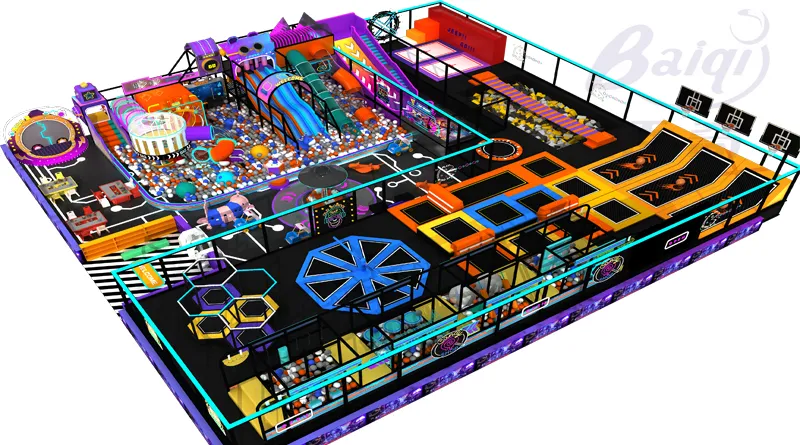
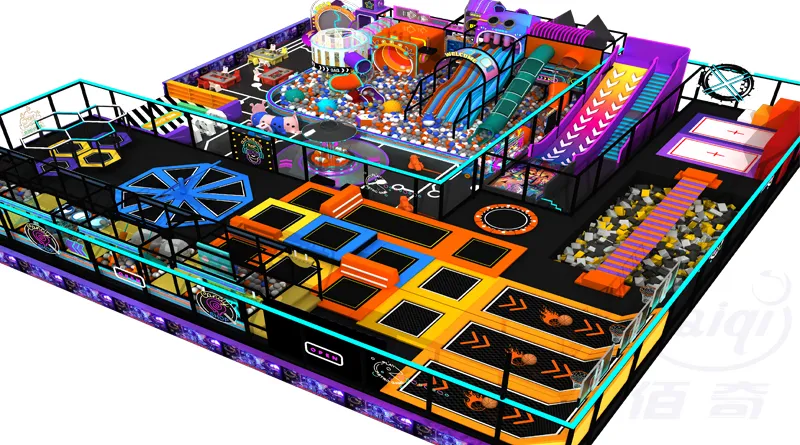
A single open jump zone is a 15‑minute experience. A five‑zone layout gives visitors reasons to stay longer and come back.
Open jump court – free bouncing, warm‑up, casual fun
Dodgeball court – team play, competition, repeat appeal for teens
Foam pit – tumbling practice, air‑awareness training
Spider wall – vertical climbing with elastic harness, kids repeat to beat their time
Ninja obstacle course – timed runs, score tracking, very high repeat appeal
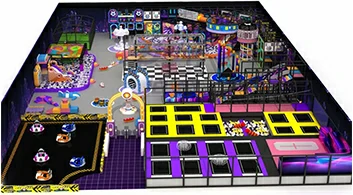
The 017 model for 100‑200m² floors reconfigures these zones based on the actual dimensions. For a narrow 100m², the designer might reduce open jump and enlarge the ninja course. For a 180m² L‑shaped space, dodgeball goes to the larger wing and spider wall occupies a corner column.
A group of five friends will jump for 15 minutes and then ask “what now”. A dodgeball court gives them a reason to stay 45 minutes, talk trash, play another round, and come back next week with a different group. Revenue per visit from a dodgeball group is 3‑5 times that of a solo jumper because they stay longer, buy more drinks, and book group events.
The 017 model allocates 20‑25% of floor area to a full‑size dodgeball court whenever space exceeds 130m². For smaller venues, the dodgeball court is replaced with a second open jump zone.
A park that sees 100,000 landings per year needs steel that does not bend, springs that do not lose tension, and padding that does not flatten.
The 017 model uses:
Galvanized steel frames (2‑3mm wall, hot‑dipped zinc coating) – resists rust from sweat and humidity
Dual spring system – primary springs around the mat plus backup springs under the frame
40mm high‑density closed‑cell foam wrapped in 0.45mm PVC leather – absorbs impact, flame‑retardant, easy to clean
Thinner padding (25‑30mm) compresses fully after 6‑12 months, exposing the steel frame. The 017 spec uses 40mm to last 3‑5 years before replacement.
Sweat from jumpers contains salt. Combined with humidity from indoor pools (if in a rec center), standard electroplated steel can rust within a year. The 017 uses hot‑dipped galvanizing, which deposits a 50‑80µm zinc layer that seals the steel even at cut edges. Rust spots on a frame are not just cosmetic – they weaken the metal and create sharp flakes that cut children’s hands.
[Image: Side view of trampoline edge showing the 40mm padding, dual spring arrangement, and galvanized steel frame with zinc coating]
An operator without safety certificates will struggle to get commercial liability insurance, or pay a premium that kills the business.
The 017 equipment meets:
EN1176 – European playground standard (structural integrity, entrapment hazards, fall zones)
ASTM F2970 – American trampoline court standard (design, installation, maintenance)
ISO 23659:2022 – International trampoline park standard (safety requirements for design, construction, inspection)
With these certificates, an insurer accepts the equipment as “built to industry standards”. Without them, the insurer may require a separate engineering inspection or refuse coverage.
The certificate documents also include load testing reports for the frame and fall height calculations for the foam pit. A pit that is too shallow for the jump height is a common cause of ankle fractures. The 017 spec calculates the required pit depth based on the maximum achievable jump height from the nearest trampoline.
A park that skips maintenance is a park that gets sued. The 017 model allocates roughly 5% of initial equipment cost to annual upkeep.
| Item | Frequency | Cost share |
|---|---|---|
| Spring replacement (3‑5% per year) | Replace worn springs, clean debris | 30‑35% |
| Jumping mat seam inspection | Check stitching at V‑ring attachments | 10‑15% |
| Padding cover repair | Patch or replace torn PVC leather | 20‑25% |
| Frame bolt torque | Retorque all bolted connections | 5‑10% |
| Netting and perimeter check | Inspect for holes or detachment | 15‑20% |
The most critical item is spring replacement. Springs weaken after about 100,000 cycles. In a 100m² park with moderate traffic, that can be as short as 6‑8 months. A weak spring reduces bounce height, which makes jumpers land harder, which accelerates wear on other springs and the mat. The 017 operator tracks installation dates and replaces springs regardless of visible condition.
The jumping mat is polypropylene webbing stitched at stress points. The webbing is strong, but the stitching at the V‑ring attachments wears from friction against the spring hook. Monthly seam inspection with a 10x loupe catches worn threads before they fail. A mat that fails at a seam while a jumper is in the air sends the jumper directly onto the spring bed. The 017 maintenance log includes a photo of each V‑ring taken every six months to track wear patterns.
The most profitable hours are the first hour of the morning and the last hour before close. Morning: group bookings (corporate team building, school trips, birthday parties). Late evening: repeat local visitors who know the park is less crowded.
The 017 model uses divisible court zones. During peak Saturday afternoons, all zones are open for general admission. During weekday mornings, the dodgeball court is reserved for group bookings, the foam pit for training classes, and the open jump court handles walk‑ins. The ninja course is open any time it is not booked.
A party area adjacent to the court seats parents directly visible from the trampoline floor. No separate observer tickets needed, and insurance requirements are satisfied. The seating capacity is about 80% of maximum visitor count to keep the rest area comfortable.
A trampoline park that fails within a year often has one of three problems. The first is wrong spring tension for the target age group. A park for kids 6‑12 needs lighter springs than a park for teenagers. The 017 design includes a spring selection table based on average jumper weight. Springs that are too stiff make light kids stomp to get height – a motion that damages the mat faster. Springs that are too soft for heavier jumpers bottom out, transferring impact to the frame.
Another common failure is skipping the backup spring. A single spring system will have a broken spring at some point. Without a backup, the mat sags and the jumper hits the frame. The 017 dual spring system includes a secondary spring that holds the mat even if the primary breaks. The operator notices a change in bounce but the jumper never contacts steel.
A third issue is neglecting netting tension. If the perimeter netting sags, a child can roll under it. The 017 maintenance checklist includes a weekly tension check using a spring scale. Loose netting is retensioned immediately. The operator who caught a sagging net before a busy Saturday avoided what could have been a serious fall.
Baiqi Playground (Wenzhou Baiqi Amusement Equipment Co., Ltd.) designs the 017 model specifically for 100‑200m² retail spaces. The equipment includes galvanized steel frames, dual springs, 40mm padding, and certified compliance with EN1176, ASTM F2970, and ISO 23659. Layouts are custom to each floor plan, with columns turned into play features and low ceilings routed around.
A trampoline park that pays off its equipment in 14 months does not come from a generic bounce floor. It comes from a spring count chosen for the weight range of its visitors, a five‑zone layout that captures repeat visits, and a maintenance schedule that replaces parts before they fail. The 017 model delivers that.
【Request a quote from Baiqi Playground】
Send your floor plan (PDF or CAD) and target age range to receive a 017 layout, equipment list, and certificate package.


Copyright © 2024 Wenzhou Baiqi Playground Equipment Co., Ltd All rights reserved.
 Get a Custom Playground Quote