
Fast Flexible and Affordable
Discover Our Playground Equipment Solutions Today!

 Feb 27,2026
One of the first and most critical questions aspiring indoor playground owners face is: "How big does my space need to be?" The answer isn't one-size-fits-all. The ideal size for your indoor playground depends on a complex mix of business goals, target audience, and available budget.
This complete guide will walk you through the standard sizes of indoor playgrounds, the factors influencing those numbers, and strategies to maximize every square meter. Whether you are planning a small soft-play corner in a café or a large Family Entertainment Center (FEC), understanding these requirements is the foundation of a successful business. Along the way, we will look at how solutions from industry manufacturers like baiqi can adapt to various spatial challenges.
The size of your indoor playground directly impacts three critical aspects of your business: safety, customer experience, and profitability.
Safety and Compliance: Adequate space is non-negotiable for safety. International safety standards (such as EN1176 or ASTM) mandate specific clearance zones around equipment—often at least 1.5 to 1.8 meters around slides and moving parts to prevent collisions. Insufficient space leads to accidents and regulatory violations.
Customer Experience and Flow: A cramped, overcrowded playground is stressful for parents and children. You need space for kids to move freely and for parents to supervise comfortably. A well-spaced layout prevents bottlenecks and improves the overall guest experience, encouraging longer stays and repeat visits.
Operational Efficiency: The size dictates your maximum capacity. Industry guidelines suggest allocating approximately 2.8 to 3.7 square meters per child to ensure a comfortable play environment. Knowing this helps you manage entry, staffing, and revenue projections.
Before looking at specific numbers, you must assess the variables that will dictate your unique space needs.
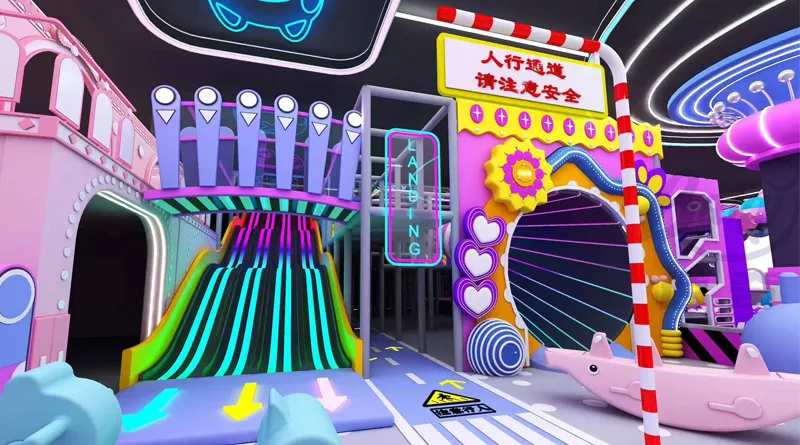
This is the biggest factor. A simple soft-play structure for toddlers has a much smaller footprint than a trampoline park or a ninja warrior course. A multi-level baiqi indoor playground structure, for example, is designed to consolidate multiple activities into a vertical footprint, saving valuable floor space.
Toddlers (1-3 years): Require smaller, ground-level activities with soft flooring. These zones can be compact but must be separated from older children.
Young Children (4-7 years): Need more interactive elements like climbing nets, tunnels, and slides, which require more square meterage.
Older Children (8-12 years): Demand adventurous activities like obstacle courses or trampolines, which have the largest space requirements.
Play equipment rarely occupies 100% of your leased space. You must account for:
Reception and Waiting Areas
Parent Seating: Comfortable viewing areas are essential.
Party Rooms: A key revenue stream that requires dedicated square meters.
Restrooms and Food Service Areas: Even a small snack bar needs space.
Pathways: Ensuring clear circulation for both children and adults.
A common rule of thumb is that the actual play zone should account for only 60-70% of your total floor area.
Don't just look at the floor; look up. Standard play structures often require a minimum clear height of 4 meters. If you plan to install large spiral slides or multi-level towers, you will likely need 5 to 6 meters or more.
To give you a practical idea, here is a breakdown of typical sizes, converted to square meters for clarity.
Typical Locations: Coffee shops, small daycare centers, restaurant play areas.
Target Age: Primarily 1-4 years old.
Equipment: Small slides, ball pits, soft blocks, and sensory panels.
Capacity: Approximately 10-20 children.
Typical Locations: Smaller retail units, community centers, stand-alone startups.
Target Age: 1-8 years old.
Equipment: Compact multi-level play frames, small trampolines, role-play cabins.
Capacity: Approximately 20-50 children. This is a popular "starter" size for many entrepreneurs.
Typical Locations: Dedicated indoor play centers, larger gymnasiums.
Target Age: Toddlers to pre-teens.
Equipment: Complex multi-level structures, obstacle courses, interactive digital floors, designated party rooms.
Capacity: Approximately 50-80 children. This is considered a very commercially viable size.
Typical Locations: Family Entertainment Centers (FECs), large commercial complexes.
Target Age: All ages.
Equipment: Themed playlands, trampoline parks, climbing walls, go-karts, VR zones, cafes, and expansive party suites.
Capacity: 80+ children.
If you are working with a smaller footprint, smart design is your best tool. baiqi specializes in creating high-play-value equipment that fits diverse spatial needs.
When floor space is limited, the only way to go is up. Utilize vertical space by investing in multi-level structures. A well-designed compact unit from baiqi can incorporate slides, climbing nets, and bridges across two or three levels, effectively tripling your play area without increasing the floor dimensions.
Don't let walls go to waste. Install wall-mounted activities like climbing walls, magnetic mazes, or interactive panels. Corners can be transformed into cozy reading nooks or compact role-play areas using corner-specific furniture.
Opt for equipment that serves multiple purposes. baiqi offers modular playground systems with interchangeable components, allowing you to customize the layout to fit irregular spaces or reconfigure it later to refresh the look. Their equipment often combines activities like slides, swings, and ball pits into one cohesive unit.
Use color, flooring changes, or low barriers to define zones clearly. This creates an organized feel and prevents the space from looking chaotic. Good traffic flow makes a small area feel larger and more inviting.
Deciding on the size involves balancing your vision with reality:
1. Define Your Concept: A high-intensity trampoline park needs space; a neighborhood soft-play café can thrive in a smaller footprint.
2. Set a Budget: Larger spaces mean higher rent, utilities, and equipment costs. Ensure your financial projections support the scale.
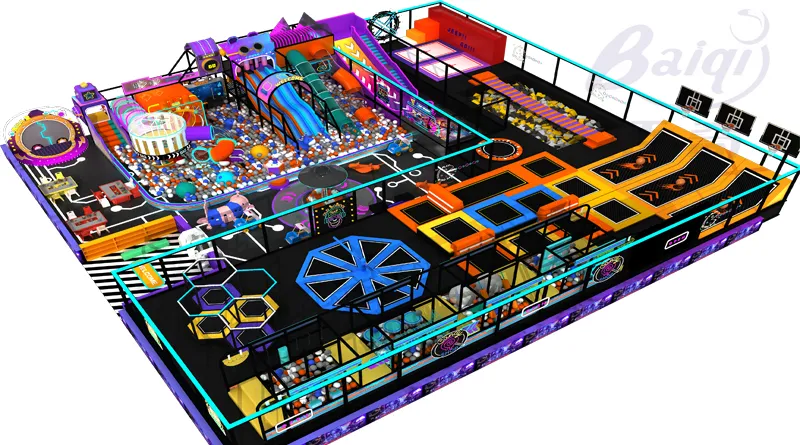
3. Consult the Experts: Work with experienced manufacturers and designers. Companies like baiqi can provide detailed 3D layouts to help you visualize how their equipment will fit into your specific space, ensuring you meet safety standards and maximize play value.
Determining how many square meters your indoor playground needs is a balancing act between ambition, budget, and practicality. By understanding the factors that influence space—from equipment types to safety clearances—you can make an informed decision that sets your business up for success.
Remember that size is not just about the raw number of square meters; it is about how effectively you use them. With strategic planning, a focus on vertical play, and the help of experienced partners like baiqi to supply safe, modular, and engaging indoor playground equipment, you can create a magical and profitable play space, regardless of its dimensions.
Q: What is the minimum space needed to start a small indoor playground?
A: For a very basic setup targeting toddlers in a café or small retail space, you might start with around 20-50 square meters. However, a standalone business is often more viable starting from 100 square meters.
Q: How much space should I allow per child in the play area?
A: For safety and comfort, it is recommended to allocate between 2.8 and 3.7 square meters of pure play space per child. This helps calculate your maximum safe capacity.
Q: What ceiling height do I need for a multi-level playground?
A: For a standard two-level structure with slides, you should look for a minimum ceiling height of 4.5 to 5 meters. For more adventurous equipment, 6 meters or higher is preferable.
Q: Can I install an indoor playground in an oddly shaped room?
A: Yes. This is where modular equipment shines. Brands like baiqi offer highly customizable and modular solutions that can be configured to fit around pillars and irregular walls, maximizing every usable square meter.
Q: Does baiqi equipment meet international safety standards?
A: Yes, baiqi indoor playground equipment is manufactured with safety as a priority, featuring galvanized steel frames and soft, padded surfaces. Their products are designed to comply with major international certifications such as CE (EN 71) and CPC (ASTM F963).
Q: How can I make my small indoor playground feel bigger?
A: Use bright colors and good lighting, install mirrors to create an illusion of depth, and most importantly, utilize vertical space with tall, compact play structures rather than spreading equipment out across the floor.


Copyright © 2024 Wenzhou Baiqi Playground Equipment Co., Ltd All rights reserved.
 Get a Custom Playground Quote